


When the U.S. government wielded the “national security” baton, attempting to erase TikTok from its app stores, a battle over digital sovereignty quietly began. Meanwhile, across the ocean, the Chinese social app Xiaohongshu unexpectedly became a beneficiary of this storm. A large number of American users, self-proclaimed as “TikTok refugees,” flooded into Xiaohongshu, seeking an alternative to TikTok and opening a new window for cultural exchange between China and the West. Is the TikTok ban truly motivated by national security concerns, or is it a manifestation of digital hegemony? Can the rise of Xiaohongshu become a new opportunity for Chinese cultural export? How will the influx of “TikTok refugees” impact cultural exchange between China and the West?
TikTok Ban: A Battle for Digital Sovereignty?
In recent years, TikTok has rapidly risen to global prominence, with its short video content and algorithmic recommendation system attracting hundreds of millions of users, especially among the younger generation. However, TikTok’s success has also raised concerns in Western countries. The U.S. government, citing “national security,” has accused TikTok’s parent company, ByteDance, of potentially leaking user data to the Chinese government and has imposed a series of restrictions on TikTok, including banning its use by government agencies and demanding that ByteDance sell TikTok’s U.S. operations.
The U.S. government’s crackdown on TikTok has sparked widespread controversy. Supporters argue that, as a Chinese company, TikTok’s data handling poses potential security risks, and banning it is a necessary measure to protect national security and user privacy. Opponents, however, point out that the U.S. government has not provided any evidence of TikTok’s data leakage risks, and the ban is politically motivated, aimed at suppressing the development of Chinese tech companies.
Behind the TikTok ban lies a new challenge to national sovereignty in the digital age. With the rapid development of the internet and digital technology, data has become a critical strategic resource. Governments worldwide are seeking to strengthen control over data to safeguard national security and economic interests. The TikTok ban can be seen as an attempt by the U.S. government to assert its digital sovereignty, but it may also lead to a series of negative consequences, including:
1. Undermining the openness and freedom of the global internet: The essence of the internet is openness and interconnectedness, but the TikTok ban artificially erects barriers, fragmenting the internet into different camps.
2. Hindering technological innovation and international cooperation: Technological innovation requires global collaboration and exchange, but the TikTok ban restricts Chinese tech companies from participating in international competition, harming the interests of the global tech industry.
3. Exacerbating mistrust and confrontation between nations: The TikTok ban has intensified tensions between China and the U.S. and may prompt other countries to follow suit, leading to the fragmentation of the global digital governance system.
Currently, ByteDance faces a difficult choice: either divest TikTok’s U.S. operations by the January 19 deadline or risk a complete ban in the U.S. The U.S. Congress has passed a forced sale order requiring ByteDance to divest TikTok’s U.S. operations by January 19. The U.S. Supreme Court will issue a final ruling on January 19, determining TikTok’s ultimate fate. If the ban takes effect, TikTok will be removed from Apple and Google’s app stores, preventing new users from downloading the app and existing users from receiving security patches and feature updates. Over time, the app may become unusable.
Reports suggest that ByteDance plans to proactively shut down the app for its 170 million U.S. users on January 19, the day the U.S. “sell or ban” law takes effect. This move aims to demonstrate the impact of the ban to all users. TikTok plans to allow users to download all their data to retain personal information records. As of now, TikTok has not responded to these reports.
How ByteDance will ultimately decide and what fate awaits TikTok remains to be seen.

The Rise of Xiaohongshu: A New Window for Cultural Export
As TikTok faces a ban, another Chinese social app, Xiaohongshu, has unexpectedly risen in the U.S. market. With its unique “grass-planting” culture and community atmosphere, Xiaohongshu has attracted a large number of users, including many “TikTok refugees.” The rise of Xiaohongshu is not only a testament to its product strength and marketing strategy but also reflects the growing influence of Chinese culture overseas.
Xiaohongshu’s features mainly include the following:
Content sharing platform: Users can share various forms of content, including images, text, and videos, covering areas such as beauty, fashion, food, and travel.
Community interaction: Users can follow bloggers of interest, like, comment, and collect content, as well as interact with other users.
E-commerce functionality: Xiaohongshu has an embedded e-commerce feature, allowing users to directly purchase recommended products.
Local lifestyle services: The platform offers recommendations and booking services for local lifestyle activities such as dining, entertainment, and hotels.
Xiaohongshu’s success can be attributed to several factors:
Precise user targeting: Xiaohongshu’s target audience is young women, and its content and features are tailored to their needs and interests.
High-quality content ecosystem: Xiaohongshu encourages users to create high-quality original content and uses an algorithmic recommendation system to push this content to target users.
Active community atmosphere: Xiaohongshu’s users frequently interact, forming a unique “grass-planting” culture where users enjoy sharing their experiences and shopping tips, influencing and recommending products to each other.
The rise of Xiaohongshu provides a new window for Chinese cultural export. The platform’s content covers various aspects of Chinese life, from food and beauty to travel and fashion, offering overseas users a new way to understand Chinese culture. The community interactions on Xiaohongshu also promote exchanges and understanding between Chinese and foreign users, helping to eliminate cultural biases and misunderstandings.
The Psychology of “TikTok Refugees”: Curiosity, Protest, or Cultural Identity?
The influx of “TikTok refugees” into Xiaohongshu has sparked curiosity about their motivations. Why did they choose Xiaohongshu as an alternative to TikTok? Are they driven by curiosity, protest, or a sense of cultural identity?
The psychology of “TikTok refugees” is complex and likely the result of multiple factors. On one hand, they may be protesting the TikTok ban by using Xiaohongshu to express their dissatisfaction with the U.S. government. On the other hand, they may be curious about Chinese culture, hoping to learn about Chinese trends and lifestyles through Xiaohongshu. Some “TikTok refugees” may have found content and communities on Xiaohongshu that interest them, leading them to stay.
Regardless of their motivations, the influx of “TikTok refugees” presents new opportunities for cultural exchange between China and the West. Their interactions with Chinese users can promote mutual understanding and respect, helping to break down cultural barriers and create a more equal and inclusive environment for cultural exchange.
In addition to American users flocking to Xiaohongshu in search of a TikTok alternative and labeling themselves as “TikTok refugees,” there are other interesting phenomena:
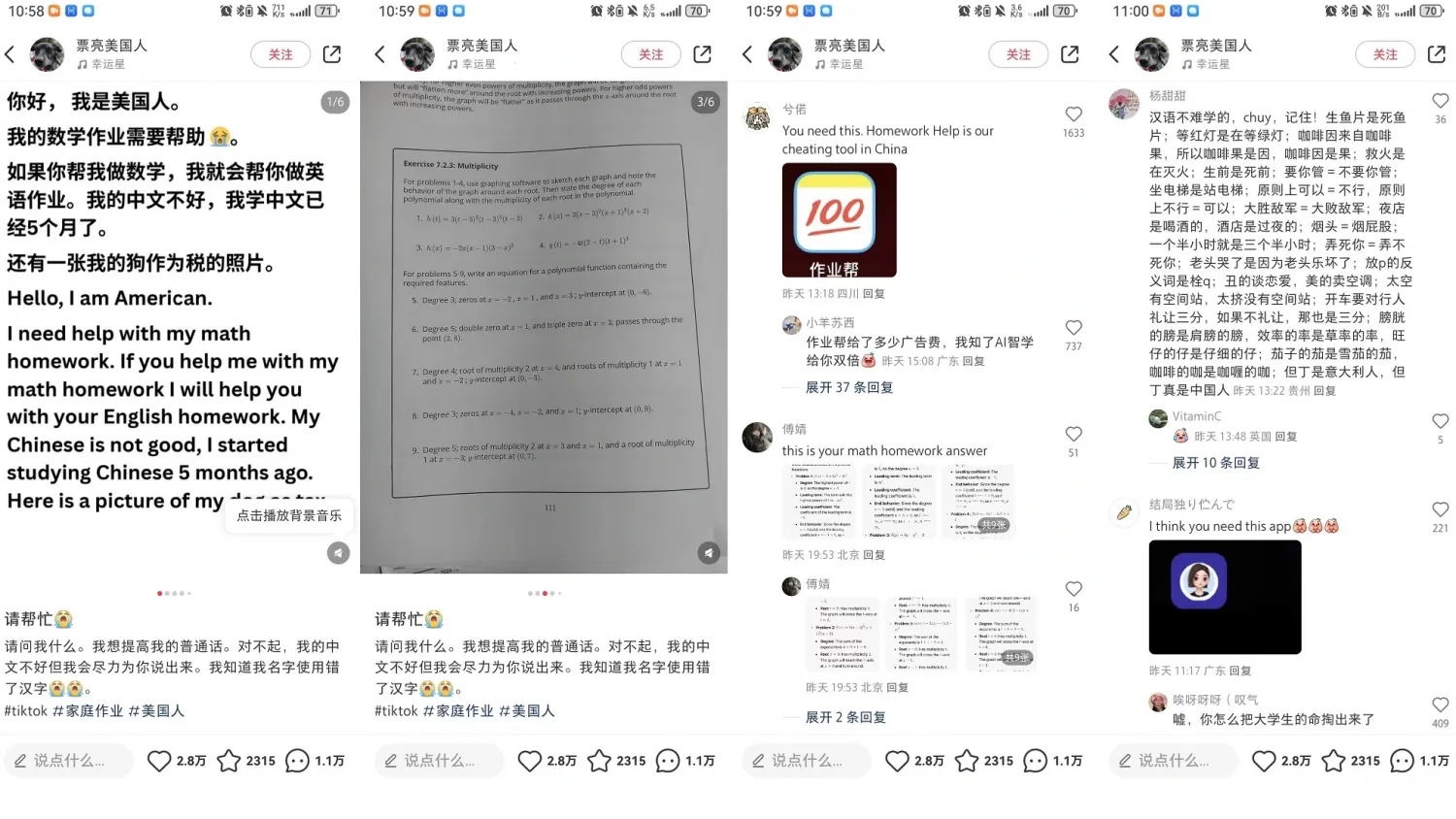
Learning Chinese and English: Some American users have started learning Chinese on Xiaohongshu, asking Chinese users for help in the comments section. Some Chinese users have enthusiastically provided study guides, and even elementary school students have offered to help with English homework.
Sharing daily life: American users have also begun sharing their daily lives on Xiaohongshu, such as food, travel, and fashion. This echoes the earlier trend of foreigners posting photos on Xiaohongshu seeking advice on makeovers, showcasing the platform’s appeal as a lifestyle-sharing platform.
Cultural collisions: Due to cultural differences, interactions between Chinese and American users on Xiaohongshu have led to some amusing collisions. For example, some American users are surprised by the warmth and friendliness of Chinese users, while some Chinese users find American users’ humor and directness refreshing.
These phenomena indicate that the rise of Xiaohongshu not only provides American users with a new social platform but also creates new opportunities for cultural exchange between China and the U.S.
Sino-Western Cultural Exchange: From Collision to Integration
Cultural exchange between China and the West has a long history, but historical and cultural differences have also led to misunderstandings and biases. In recent years, with China’s economic rise and increasing international influence, cultural exchanges between China and the West have become more frequent but also face new challenges.
The TikTok ban and the rise of Xiaohongshu present both opportunities and challenges for Sino-Western cultural exchange. On one hand, the TikTok ban reflects Western countries’ concerns about the influence of Chinese culture and exposes the obstacles in Sino-Western cultural exchange. On the other hand, the rise of Xiaohongshu showcases the charm and appeal of Chinese culture and provides a new platform and channel for Sino-Western cultural exchange.
In the digital age, social media has become an important tool for cultural dissemination. Platforms like TikTok and Xiaohongshu offer a window for Chinese and Western users to understand and interact with each other. Through these platforms, users can share their cultures, lifestyles, and values, promoting mutual understanding and respect.
In the Digital Age, Culture Knows No Boundaries
The TikTok ban, the rise of Xiaohongshu, and the phenomenon of “TikTok refugees” are microcosms of cultural exchange in the digital age. These events demonstrate that in the digital era, cultural dissemination is faster, broader, and more influential, but also more complex and diverse.
Faced with the trends of cultural exchange in the digital age, we should actively embrace change, using digital technology to promote communication and integration between different cultures. At the same time, we must remain vigilant about the risks and challenges posed by digital technology, such as cultural hegemony, information bubbles, and cybersecurity issues.
In the digital age, culture knows no boundaries. Only by strengthening dialogue, enhancing understanding, and eliminating biases can we build a more harmonious, inclusive, and diverse environment for cultural exchange, allowing different cultures to develop together through interaction and collision, contributing to the progress of human civilization.