
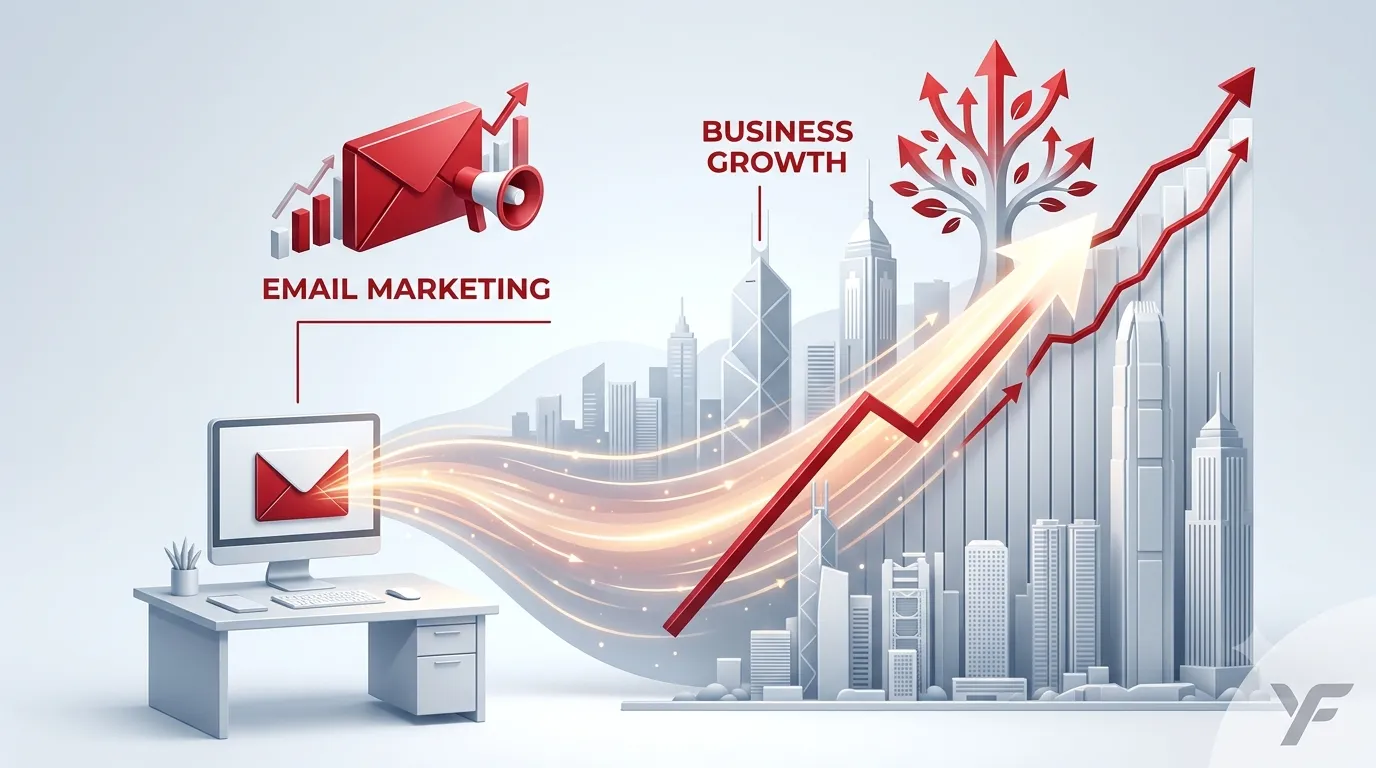
In Hong Kong’s highly digitalized market, businesses face increasingly fierce competition. With social media algorithms constantly shifting and advertising costs continuing to rise, one marketing channel consistently maintains stable and highly effective performance — Email Marketing.
According to data from international research institutions, the average return on investment (ROI) for email marketing is as high as 38:1, meaning that every $1 invested can yield a return of $38. By comparison, the cost-effectiveness of channels like social media ads and search engine advertising is often much lower. For growing businesses in Hong Kong, email marketing is not only a cost-effective choice but also a key tool for building long-term customer relationships and enhancing brand trust.
As a digital marketing company deeply rooted in the Hong Kong market for over 20 years, YouFind has witnessed countless Hong Kong businesses achieve breakthroughs through email marketing. Starting from the practical needs of Hong Kong enterprises, this article will introduce the core concepts and implementation strategies of email marketing in detail, as well as how to integrate email marketing with other channels such as SEO and content marketing to maximize your marketing ROI.
What is Email Marketing?
Definition and Core Value
Email marketing refers to the practice of businesses sending targeted marketing messages to existing and potential customers via email to increase brand awareness, drive sales, and build customer loyalty. Unlike “rented media” such as social media and search engine advertising, email is an “owned media” channel that you truly own and control.
This point is particularly crucial for Hong Kong businesses. Imagine if you rely solely on Facebook or Instagram to reach your customers, and one day the platform changes its algorithm or restricts your account — you will lose direct contact with your audience. With email, however, you hold the contact information of your customers, making it a permanent asset.
What is the Difference Between EDM and Email Marketing?
In the Hong Kong and Taiwan markets, you may often hear the terms EDM (Electronic Direct Mail) and Email Marketing. While they are frequently used interchangeably, there are subtle differences. EDM emphasizes the concept of “direct mail” — similar to traditional direct mail advertising but delivered electronically. EDM is usually more promotional and advertising-oriented. In contrast, Email Marketing is a broader concept that encompasses all marketing activities conducted via email, including newsletters, customer relationship management (CRM), automation sequences, and more. In this article, we use “Email Marketing” to refer to all marketing activities conducted via email, including traditional EDM.
Why Should Hong Kong Businesses Value Email Marketing?
Own a True Customer List
On social media platforms, even if you have 100,000 followers, each post can typically only reach 0.1% to 5% of your audience. In contrast, email marketing ensures that your messages are delivered directly to your subscribers’ inboxes. According to statistics, there are over 4.5 billion email users worldwide, and that number is expected to exceed 4.8 billion by 2027 . In Hong Kong, email remains the most trusted and widely used communication tool.
Highly Efficient Cost Structure
The cost of email marketing is extremely low. Using professional email service platforms (such as Mailchimp, Brevo, etc.), you can send messages to thousands of customers at a cost of less than HKD 0.5 per email. By comparison, the costs of traditional advertising and social media advertising are often 30 to 60 times higher. For Hong Kong startups and SMEs, this means achieving a greater impact with a limited marketing budget.
Measurable Results and Data-Driven Decisions
Email marketing platforms provide detailed analytical data — open rates, click-through rates, conversion rates, unsubscribe rates, and more. This data allows you to accurately understand customer behavior, optimize marketing strategies, and clearly demonstrate the value of marketing investments to management. This is particularly important for Hong Kong businesses that need to prove their ROI.
Personalization and Segmentation Capabilities
Modern email marketing platforms allow you to perform precise segmentation based on customers’ purchase history, browsing behavior, geographic location, interests, and more, enabling you to send highly personalized messages. Research shows that personalized email open rates are 26% higher than generic emails.
Common Types of Email Marketing for Hong Kong Businesses
Welcome Email
When a new customer subscribes to your email list, the welcome email is their first impression. A well-designed welcome email should thank the customer for subscribing, briefly introduce your brand and value proposition, set expectations for future emails, and provide a first-purchase discount or exclusive offer. For Hong Kong businesses, welcome emails are key to building trust. Many Hong Kong consumers are cautious about unfamiliar email marketing; a professional, valuable welcome email can significantly increase the open rate of subsequent emails.
Newsletter
Regular newsletters are an effective way to stay in touch with customers. You can share industry insights, product updates, customer stories, educational content, and more. For Hong Kong businesses, newsletters should provide genuine value rather than pure advertising, reflect the specific needs and trends of the Hong Kong market, contain actionable advice or insights, and maintain a consistent delivery frequency (usually weekly).
Promotional Email
Promotional emails are used to promote specific products, services, or offers. An effective promotional email should have a clear call-to-action (CTA), highlight the time limit of the offer to create a sense of urgency, target specific customer segments, and avoid excessively frequent promotions to prevent unsubscribes. In the Hong Kong market, promotional emails are particularly effective because Hong Kong consumers are highly sensitive to time-limited offers and discounts.
Abandoned Cart Email
When a customer adds an item to their cart but does not complete the purchase, an abandoned cart email can effectively remind them to complete the transaction. These emails typically bring a 20-40% increase in conversion rates.
Re-engagement Email
Targeted at customers who have not interacted with you for a long time, re-engagement emails aim to awaken their interest. This could include special offers, new product introductions, or a simple “We miss you” message.
Transactional Email
Transactional emails such as order confirmations, shipping notifications, and refund confirmations not only provide essential information but are also opportunities to reinforce brand impressions. Many Hong Kong businesses overlook the marketing potential of transactional emails.
Core Advantages of Email Marketing
Incredible Return on Investment
According to multiple studies, the ROI of email marketing far exceeds that of other digital marketing channels. A study by Litmus indicates an average ROI of 38:1, with some brands even reaching 46:1. Data from Email Monday shows that the average ROI in the US and UK is between 3600% and 3800%, meaning that every $1 invested can yield a return of $36 to $38.
ROI Comparison Across Different Industries
The ROI of email marketing varies by industry. Below is an industry ROI comparison based on international research, which can help Hong Kong businesses understand their own industry benchmarks:
| Industry | Average ROI | Description |
|---|---|---|
| Retail and E-commerce | 45:1 | Highest ROI, as emails directly drive sales |
| Marketing, PR, and Advertising | 42:1 | These industries themselves excel at email marketing |
| Software and Technology | 36:1 | B2B sector, ROI remains very high |
| Media, Publishing, Events, Sports, and Entertainment | 32:1 | Used to promote events and content |
| Financial Services | 28:1 | Subject to regulatory restrictions, but still has a good ROI |
| Non-profit Organizations | 25:1 | Used for fundraising and member engagement |
For Hong Kong businesses, you can use this data as a benchmark for your industry. If your ROI is below the industry average, it may indicate that your strategy needs optimization.
Direct Impact on Purchasing Decisions
Studies show that consumers are three times more likely to make a purchase from email marketing than from social media. In addition, 59% of consumers say that email marketing influences their purchasing decisions. In Hong Kong, this number may be even higher, as local consumers tend to obtain product information and promotions via email.
Round-the-Clock Customer Reach
With 85% of users accessing emails via smartphones, email marketing can reach your customers 24/7, 365 days a year, no matter where they are. This is particularly valuable for businesses that serve Hong Kong customers globally or need to communicate across time zones.
Complete Data Ownership
Unlike on social media, you completely own the customer data in your email list. This not only means you are immune to platform algorithm changes, but it also means you can access and analyze this data at any time to improve your marketing strategies.
Brand Trust and Long-Term Success
While subject lines, design, and CTAs are all important, research shows that brand impression is the most crucial factor determining the long-term success of email marketing. Think about it: if you subscribe to emails from a brand you trust and love, you are still likely to open them even if the subject line isn’t particularly catchy. Conversely, if you have a poor impression of a brand, you will probably delete the email no matter how compelling the subject line is.
This is why long-term brand building is vital for email marketing. You should maintain consistency, ensuring every email reflects your brand values and style; provide genuine value instead of just sending promotional emails; build trust by delivering on your promises and respecting your customers’ time and privacy; and treat it as a long-term investment rather than expecting one or two emails to instantly drive conversions. By continuously providing value and building trust, you will gradually elevate your brand impression, thereby boosting open rates, click-through rates, and conversion rates.
Email Marketing Best Practices for Hong Kong Businesses
Building a High-Quality Email List
Organic Growth Is Key
Never buy email lists. Purchased lists typically contain contacts who are not interested, leading to high unsubscribe rates and low conversion rates. Instead, you should build your list organically through the following methods:
- Website Signup Forms: Place subscription forms on your website homepage, blog posts, and product pages
- Pop-Up Forms: Display exit-intent pop-ups to offer incentives (e.g., discount codes, free whitepapers) when visitors are about to leave
- Social Media Promotion: Promote your email subscription on platforms like Facebook, Instagram, and LinkedIn
- Offline Events: Collect email addresses at events such as exhibitions, trade shows, and seminars
- Content Upgrades: Offer free industry reports, templates, e-books, etc., in exchange for email addresses
For Hong Kong businesses, especially B2B companies, LinkedIn and industry forums are highly effective channels for collecting high-quality email addresses.
Set Clear Expectations
When customers subscribe to your email list, clearly inform them about the type of content they will receive and how often. This helps reduce subsequent unsubscribes and complaints.
Segment Your List
Not all customers are the same. Segment your list based on the following factors and send targeted content:
- Purchase History: Send relevant upselling or cross-selling messages to customers who have purchased specific products
- Behavior: Send relevant content based on customers’ behavior on your website (such as pages browsed, resources downloaded)
- Geographic Location: Send localized messages tailored to customers in different areas of Hong Kong
- Customer Lifecycle: New, active, and inactive customers should receive different messages
- Interests: If you offer multiple products or services, segment based on customers’ interests
Segmentation can significantly boost open and conversion rates. Research indicates that segmented emails have an open rate that is 14.31% higher than non-segmented emails.
Writing Compelling Subject Lines
The subject line is the critical factor determining whether customers open your email. An effective subject line should be concise and clear (keep it under 50-60 characters so it displays fully on mobile devices), personalized (include the recipient’s name or other personal information), create a sense of urgency (using words like ‘limited time,’ ‘today,’ or ‘last chance’), spark curiosity (ask a question or hint at valuable information), and avoid spammy words (do not use terms like “free” or “buy now” that are easily filtered).
For Hong Kong businesses writing subject lines in Traditional Chinese, care should be taken to avoid overusing symbols or emojis, as this may be perceived as unprofessional.
Designing Clean, Mobile-Friendly Emails
Simplicity Over Fancy Design
A common mistake many businesses make is over-designing their emails. In fact, simple, text-based emails often achieve higher open and click-through rates. This is because over-designed emails are easily flagged as spam by email filters; simple emails look more like personal messages rather than ads; and text-based emails load much faster, especially in areas with slower network connections.
Optimizing for Mobile Devices
Since 85% of users access emails via mobile devices, your emails must look perfect on small screens. Ensure you use a single-column layout instead of multiple columns, make buttons large enough to be easily tapped, keep font sizes at a minimum of 14px, and include alt text for images.
Technical Best Practices in Email Design
In addition to visual design, the following technical points are crucial for email deliverability and user experience:
- Responsive Design: Use CSS media queries to ensure your emails display correctly on all screen sizes
- Image Optimization: Compress images to reduce load time, add alt text to all images, and avoid using too many images
- Font Selection: Use web-safe fonts (e.g., Arial, Verdana, Georgia) and avoid custom fonts
- Colors and Contrast: Ensure there is sufficient contrast between text and background, and avoid using too many colors
- Links and Buttons: Use clear, underlined links, and make sure buttons are at least 44×44 pixels
- Code Quality: Use table-based layouts instead of divs, inline CSS instead of external stylesheets, and validate your HTML code
- Preview Text: Set up “preview text” (or preheader), which is the summary snippet displayed right below the subject line
- Testing: Test your email across multiple clients (Gmail, Outlook, Apple Mail, etc.) before sending
Include a Clear Call to Action (CTA)
Every email should have a clear purpose and a corresponding CTA. Whether it is “Buy Now,” “Learn More,” or “Download Report,” the CTA should clearly state what happens after clicking, be visually prominent using contrasting colors and ample white space, be positioned at key locations in the email (typically at the top and bottom), and use action-oriented language (such as “Get Started Now” instead of “Click Here”).
Optimize Sending Time and Frequency
Sending Time Matters
Research shows that sending time has a significant impact on open rates. Generally speaking, B2B companies see higher open rates on weekdays between 9:00 AM and 11:00 AM, or 2:00 PM and 3:00 PM, while B2C companies experience higher open rates between 7:00 PM and 9:00 PM on weekdays, or during weekend mornings. For Hong Kong businesses, the Hong Kong time zone (GMT+8) and target customers’ work habits should be taken into account.
Reasonable Sending Frequency
Sending emails too frequently leads to high unsubscribe rates, while sending too rarely can make customers forget your brand. It is generally recommended to send newsletters once a week, promotional emails as needed but no more than 2 to 3 times per month, 3 to 5 welcome emails within the first 7 days before transitioning to a regular frequency, and additional emails on special occasions (such as holidays, product launches, or major announcements).
Conduct A/B Testing
Continuous optimization is key to the success of email marketing. Conduct regular A/B testing to compare the performance of different variables, including: subject lines (test different wording, lengths, and levels of personalization), sender name (company name vs. real person name), sending time (different dates and times), content (different messages, images, and CTA text), and design (different layouts, colors, and fonts). Through systematic A/B testing, you can progressively boost open rates, click-through rates, and conversion rates.
Monitor and Analyze Key Metrics
Open Rate
Definition: The percentage of successfully delivered emails that are opened. Calculation: Open Rate = (Number of Opens ÷ Number of Successfully Delivered Emails) × 100%. The average open rate is around 19-21%, varying by industry. If your open rate is below the industry average, you should evaluate your subject lines, sending times, and list quality.
Click-Through Rate (CTR)
Definition: The percentage of recipients who click on a link within the email. Calculation: CTR = (Number of Clicks ÷ Number of Successfully Delivered Emails) × 100%. The average CTR is around 2-3%. If your click-through rate is low, it may indicate that your content or CTA is not engaging enough.
Conversion Rate
Definition: The percentage of recipients who complete a target action (such as a purchase, form submission, or download). This is the most critical metric as it directly reflects the business value of your email marketing.
Unsubscribe Rate
Definition: The percentage of recipients who choose to opt out of your email list. The average unsubscribe rate is around 0.5-1%. A high unsubscribe rate may indicate that the sending frequency is too high or the content is irrelevant.
Spam Complaint Rate
Definition: The percentage of emails marked as spam by recipients. Keep this rate below 0.1% to maintain your sender reputation. Although the spam complaint rate might seem like a minor metric, it has a massive impact on your sender reputation. If the complaint rate gets too high (typically exceeding 0.1%), inbox service providers (like Gmail and Outlook) may automatically direct your emails to the spam folder, throttle your sending rate, or block your emails entirely.
To reduce complaint rates, you should only send emails to individuals who have opted in, clearly identify your company name and contact details within the email, provide a one-click unsubscribe option, ensure email content aligns with recipient expectations, avoid over-sending, and regularly monitor complaint rates to investigate the underlying causes of complaints. By proactively managing your spam complaint rate, you can safeguard your sender reputation and ensure your emails land in the inbox rather than the spam folder.
Compliance with Hong Kong Regulations
Personal Data (Privacy) Ordinance (PDPO)
In Hong Kong, email marketing is regulated by the Personal Data (Privacy) Ordinance (PDPO). As a Hong Kong business, you must ensure:
Explicit Consent
When collecting customers’ email addresses, you must obtain their explicit consent. Simply pre-ticking a default option is not enough—customers must actively opt in to receive your emails.
Clear Identification
Every email must clearly identify the sender (your company name). Do not use misleading sender names.
Effective Unsubscribe Mechanism
Every email must include a clear, easy-to-use unsubscribe option. Customers should be able to opt out with a single click, and you must process unsubscribe requests within 10 business days.
Data Security
Customers’ email addresses and personal data must be properly protected against unauthorized access or disclosure.
Violating the PDPO can result in fines and legal action. Therefore, it is recommended that all Hong Kong businesses consult with legal experts to ensure full compliance before launching email marketing campaigns.
Building Trust in the Era of Data Privacy
In an era of increasingly strict privacy regulations such as GDPR and PDPO, customers are more concerned about data privacy than ever before. As a Hong Kong business, you should demonstrate your commitment in the following areas:
Transparent Data Policies
Clearly explain how you collect, use, and protect customer data. Provide an easily accessible privacy policy.
Explicit Consent Mechanisms
Do not use pre-ticked checkboxes or hidden consent options. Allow customers to explicitly and actively consent to receiving your emails.
Data Security Measures
Use encryption technologies to protect customer data, conduct regular security audits, and restrict access to customer data.
Respecting Customer Preferences
Provide a preference center to let customers choose the types of emails they wish to receive, respect their frequency preferences, and promptly process unsubscribe requests.
Transparent Communication
Clearly state why you are sending a particular email, explain how you use customer data to personalize emails, and regularly communicate your privacy practices with customers.
By demonstrating a commitment to privacy and security, you can build customer trust, which in turn enhances the effectiveness of your email marketing.
Email Strategies Across the Customer Lifecycle
Customers at different stages require different email strategies. Below is a complete customer lifecycle model:
Stage 1: Awareness
- Goal: Build brand awareness and attract potential customers
- Email Types: Educational content, industry insights, free resources
- Examples: “5 Ways to Boost Sales,” “Industry Trend Report”
Stage 2: Consideration
- Goal: Educate potential customers and help them evaluate your products/services
- Email Types: Product comparisons, case studies, customer testimonials
- Examples: “Why Choose Us Over Competitors,” “Customer Success Stories”
Stage 3: Decision
- Goal: Facilitate purchasing decisions
- Email Types: Special offers, limited-time discounts, free trial invitations
- Examples: “Get 20% Off Your Purchase Today,” “Start Your Free Trial”
Stage 4: Purchase
- Email Types: Order confirmation, shipping notification, receipt
- Importance: Ensure smooth transaction processes and build post-purchase confidence
Stage 5: Retention
- Goal: Ensure customer satisfaction and promote repeat purchases
- Email Types: Product tutorials, customer support, exclusive member offers
- Examples: “How to Maximize Your Purchase,” “VIP Member Exclusive Discounts”
Stage 6: Advocacy
- Goal: Turn satisfied customers into brand advocates
- Email Types: Referral programs, review invitations, community invitations
- Examples: “Refer a Friend and Get Rewarded,” “Share Your Story”
By sending relevant and valuable emails at each stage, you can effectively guide customers through the entire lifecycle and maximize customer lifetime value (LTV).
Synergy Between Email and Other Marketing Channels
The true power of email marketing lies in its synergy with other marketing channels.
Email + Social Media
Promote your email subscription on social media (“Subscribe to our newsletter for exclusive content”), include social sharing buttons in your emails to encourage subscribers to share your content, and use social media ads to retarget individuals who haven’t opened your emails.
Email + Search Advertising (SEM)
Use email lists to create search ad audiences, display relevant search ads to people who have opened your emails, and include email subscription CTAs in your search ads.
Email + CRM
Use your CRM system to track all customer interactions with you (email opens, clicks, purchases, etc.), perform highly personalized email segmentation based on CRM data, and automatically trigger emails based on customer behaviors recorded in the CRM.
Email + Web Analytics
Track the behavior of visitors clicking through from emails to your website, send follow-up emails based on their website behavior, and use web analytics data to optimize your email content.
Email + Content Marketing
The high-quality blog posts, whitepapers, and case studies you work hard to create should be emailed to your subscribers to expand content reach, boost engagement, and build thought leadership. Your blog posts and other content should include clear email subscription CTAs, leverage “content upgrades” in exchange for email addresses, and place pop-up subscription forms on high-traffic posts.
Email + SEO
While email itself does not directly impact search rankings, it can support your SEO efforts by increasing social shares of your content (subscribers are more likely to share your content, increasing backlinks), improving user signals (drawing repeat visitors through email to improve on-site user behavior signals), and supporting long-term content strategies (email helps you build and maintain a stable audience base, supporting your long-term SEO investments).
By integrating these channels, you can create a robust, multi-channel marketing system that maximizes customer engagement and conversion rates.
Common Email Marketing Mistakes of Hong Kong Businesses
Mistake 1: Over-Promotion
Many Hong Kong businesses view their email list as a quick sales channel, frequently blasting promotional emails. This often leads to high unsubscribe rates and low conversion rates. Remember, the primary purpose of email is to build relationships; promotion is secondary. We recommend following the 80/20 rule: 80% of your emails should provide value (educational, entertaining, inspiring), and 20% can be promotional.
Mistake 2: Ignoring Mobile Optimization
Many businesses design emails on desktop without considering the mobile user experience. Since most users access email via their phones, this is a major mistake. It is recommended to always test your emails across multiple devices to ensure they look perfect on mobile.
Mistake 3: Buying Email Lists
Purchased lists typically contain invalid addresses or uninterested contacts, which leads to high unsubscribe rates, low conversion rates, and can even damage your sender reputation. It is recommended to invest time in growing your list organically. Quality is far more important than quantity.
Mistake 4: Lack of Personalization
Sending generic, mass emails to all subscribers is a missed opportunity. Modern email platforms allow for a high degree of personalization. We recommend using at least the recipient’s name, or even better, segmenting and personalizing based on purchase history, behavior, and interests.
Mistake 5: Neglecting Analytics
Many businesses send emails but never review the results. This means they are missing out on opportunities to optimize and improve. It is recommended to regularly check metrics like open rate, CTR, and conversion rate, and adjust your strategy based on this data.
Email Marketing Tools and Platforms for Hong Kong Businesses
Choosing the right email marketing platform is crucial to your success. Here are some excellent options suited for Hong Kong businesses:
| Platform | Features | Suitable Business Types | Pricing |
|---|---|---|---|
| Mailchimp | Free plan, easy to use, rich integrations | Startups, small businesses | Free to $350/month |
| Brevo | Supports Chinese, good localization, powerful automation | SMEs, E-commerce | Free to €300/month |
| HubSpot | Complete CRM and marketing automation | Growing businesses, B2B | $50 to $3,200/month |
| ActiveCampaign | Advanced automation, AI-driven | Mid-to-large enterprises | $19 to $229/month |
| Klaviyo | E-commerce optimized, powerful analytics | E-commerce enterprises | $20 to $1,200+/month |
For Hong Kong businesses, it is recommended to choose a platform that supports Traditional Chinese and offers excellent localization support.
Formulate Your Email Marketing Strategy
Step 1: Define Your Goals
What are your email marketing goals? Is it to increase sales, build brand awareness, enhance customer loyalty, or all of the above? Having clear goals will guide your strategy.
Step 2: Define Your Target Audience
Who is your ideal customer? Understand their demographics, behaviors, pain points, and needs. This will help you create relevant content.
Step 3: Build Your Email List
Start building your list organically. Set up subscription forms, create content upgrades, and leverage social media and other channels.
Step 4: Plan Your Content Calendar
Plan the types of emails you will send over the next 3 to 6 months, including welcome sequences, newsletters, promotional emails, special event campaigns, and more.
Step 5: Choose Platforms and Tools
Select the right email marketing platform based on your needs and budget.
Step 6: Create and Send Your First Batch of Emails
Begin creating and sending out your emails. Do not chase perfection — just take action, and make improvements based on feedback as you go.
Step 7: Monitor and Optimize
Regularly check your metrics, perform A/B testing, and optimize your strategy based on data.
Email marketing is one of the most effective and cost-efficient ways for Hong Kong businesses to achieve sustainable growth. Whether you are a startup, an SME, or a large enterprise, email marketing should be a core component of your digital marketing strategy.
The key is to view email marketing as a tool for building long-term customer relationships, rather than a quick sales channel. By providing value, personalizing communication, and continuously optimizing, you can build a highly engaged subscriber community that drives sustainable growth for your business.
At YouFind, we have helped hundreds of Hong Kong businesses achieve significant business growth through email marketing. If you want to learn how to integrate email marketing with SEO, content marketing, and other channels to maximize your marketing ROI, we would be delighted to discuss this with you.
Start your email marketing journey today. Contact us for a free consultation.