
Does your website host hundreds or even thousands of images? Are you still spending countless hours manually filling out Alt Tags for every single one? This is more than just a tedious, repetitive chore—it is a “black hole” that devours your most valuable time. In today’s landscape, where website visibility and operational efficiency are paramount, many webmasters and marketers face a critical choice: should you use highly efficient Artificial Intelligence (AI) tools for automated generation, or stick to time-consuming but potentially more accurate manual writing?
We take a deep dive into the strengths and limitations of AI versus manual labor in writing image Alt Tags. We also reveal how professional services can masterfully combine the best of both worlds to deliver a “90% time-saving” efficiency promise, while strictly adhering to the professional standards of “Best Practices for Image Alt Tag SEO Copywriting,” ensuring every image becomes an asset that drives traffic and boosts rankings.
AI-Written Alt Tags: An Efficiency Revolution and Its Potential Traps
The rise of AI tools has indeed brought an unprecedented surge in efficiency to the cumbersome task of Alt Tag optimization. The advantages are obvious, primarily manifesting in speed and scalability. An AI tool can scan and generate basic descriptions for hundreds of images in seconds—a feat that can save up to 90% of initial time costs for e-commerce sites or content platforms with massive image libraries. Furthermore, modern image recognition AI has reached a high level of accuracy, identifying primary objects and scenes to provide basic descriptions like “a person running” or “a laptop on a desk.”
However, completely delegating the responsibility of “Best Practices for Image Alt Tag SEO Copywriting” to AI may hide the following fatal limitations:
| AI Limitations | Specific Impact |
|---|---|
| Lack of Business Intent Understanding | AI can only provide objective descriptions; it cannot understand the “marketing role” of an image or the user’s “search intent.” For example, for an image showing the “Central Hong Kong Night View,” an AI might only label it as such. However, professional Best Practices for Image Alt Tag SEO Copywriting require asking: is this for a hotel promotion, a travel blog, or a photography portfolio? Target keywords might be “Luxury Hotel Views in Hong Kong” or “Victoria Harbour Night Photography Spots”—strategic thinking that AI currently struggles to replicate. |
| Stiff and Mechanical Keyword Integration | When integrating specific keywords, AI often sounds robotic, leading to unnatural or repetitive phrasing. This can be flagged by search engines as keyword stuffing, which harms rankings. Excellent copy needs to weave keywords like “Hong Kong SEO Services” naturally into the description rather than forcing them in. |
| Ignoring Accessibility Standards | The original purpose of Alt Tags is to help visually impaired users understand image content via screen readers. AI-generated descriptions may miss critical context or fail to clearly describe complex infographics, failing to meet strict Web Content Accessibility Guidelines (WCAG) and potentially impacting a company’s CSR image. |
The Value of Professional Manual Writing: What are the “Best Practices for Image Alt Tag SEO Copywriting”?
So, where does the irreplaceable nature of professional manual writing lie? It’s not just about “writing a description”; it’s about crafting strategic content that meets the “Best Practices for Image Alt Tag SEO Copywriting“ standard. This standard consists of three core pillars:
- Keyword Strategy Integration: Before writing, professionals analyze the page’s core theme and relevant long-tail keywords. Each Alt Tag is not an island; it is an extension of the overall page content strategy, designed to support main keyword rankings and capture niche image search traffic.
- User Experience First: Descriptions must be clear, concise, and accurate. Even if an image fails to load, users should be able to gain all key information from the text. This requires the writer to fully understand the message the image conveys and its value to the user.
- Compliance with Search Engine and Accessibility Guidelines: Professionals are well-versed in the latest image search best practices, including appropriate character length, punctuation use, and how to avoid penalties. Simultaneously, they ensure the description provides an equal access experience for all users.
In short, the difference lies between “knowing how to write an Alt Tag” and “mastering Best Practices for Image Alt Tag SEO Copywriting.” The latter is an art form that merges marketing insights, user psychology, and technical specifications—this is exactly where human professional experience adds value.
The Ultimate Solution: A “Golden Workflow” Combining AI Efficiency and Human Intelligence
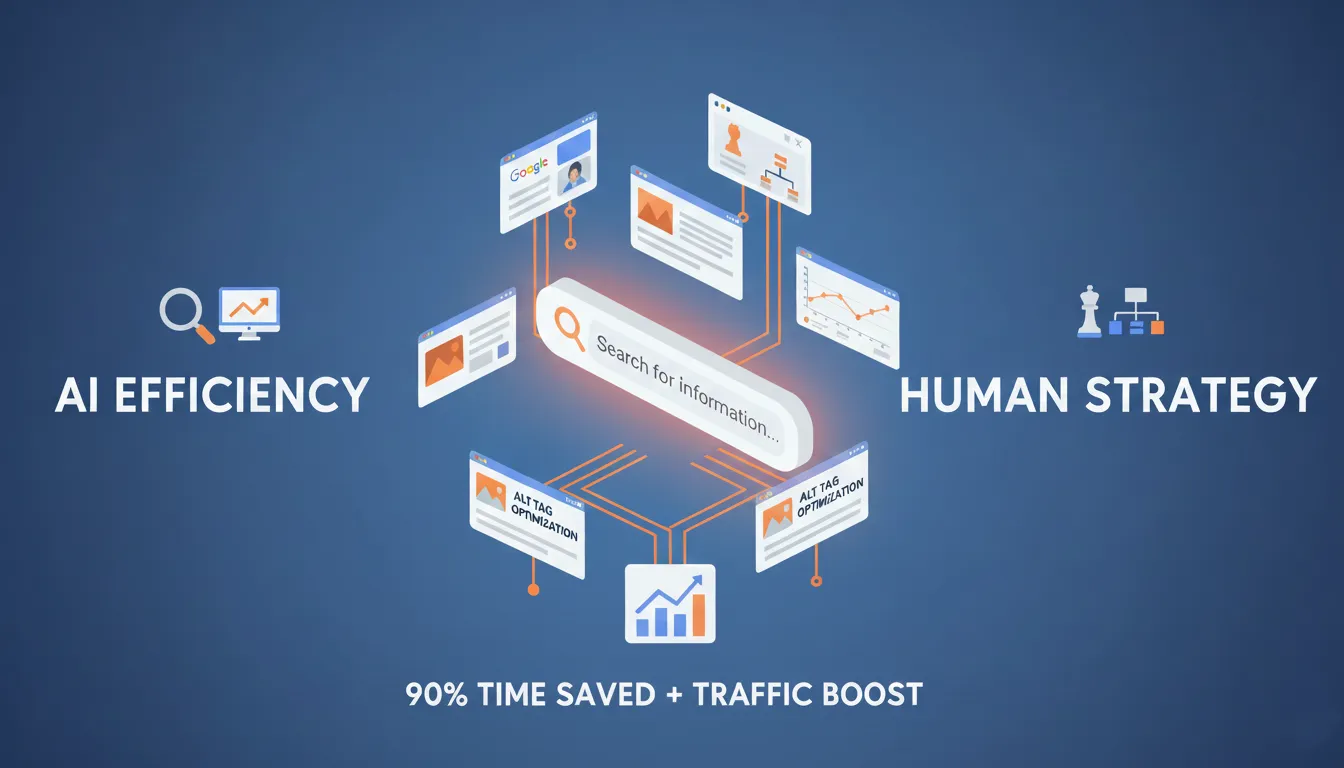
Faced with the dilemma of “efficiency” versus “effectiveness,” top-tier professional services don’t choose one over the other. Instead, they creatively blend both to design a “Golden Workflow” that achieves the 90% time-saving promise while ensuring professional quality.
- Step 1: AI-Driven Preliminary Processing (Efficiency Phase) Utilize advanced AI tools to perform batch scans and basic tagging of all website images. This step is like using a high-speed scanner; it completes 80% of the massive workload in a very short time, forming the foundation of our “90% time-saving” claim. It handles all obvious objective descriptions, freeing human labor from repetitive tasks.
- Step 2: Expert Manual Review and Strategic Correction (Effectiveness Phase) A team of professional optimization specialists then steps in. They review the AI-generated results one by one, correcting recognition errors and adjusting the focus of the description based on the page context. This ensures accuracy and situational relevance.
- Step 3: Strategic Keyword Injection and Accessibility Optimization (Value-Add Phase) This is the most critical step and the essence of Best Practices for Image Alt Tag SEO Copywriting. Experts naturally weave target keywords into the descriptions based on a pre-set strategy and optimize the copy for accessibility. For instance, an AI-generated “Meeting room photo” is transformed into “Professional meeting room at a Hong Kong virtual office service, equipped with video conferencing facilities.” This isn’t just a description—it’s high-value marketing copy.
We recently assisted a local retail brand in efficiently processing over 5,000 product images within two weeks using this hybrid workflow. The result? Three months later, their organic traffic from image searches increased by over 40%—a direct outcome of implementing Best Practices for Image Alt Tag SEO Copywriting.
Let Professional Services Unlock the True Potential of Your Images
AI is a powerful efficiency tool, but it lacks strategic marketing vision and a human touch. Pure manual writing is precise but prohibitively expensive in terms of time. The value of a professional third-party service lies in a smart workflow that perfectly marries the strengths of both.
You no longer have to struggle between “fast but average” and “accurate but slow.” Save your time for your core business and leave the Best Practices for Image Alt Tag SEO Copywriting to us. Let us help you turn the silent images on your website into valuable assets that consistently bring in target traffic and enhance brand visibility. Contact our team today for an initial assessment and take your first step toward high-efficiency optimization.