
In the SEO competitive landscape of 2026, relying solely on keyword coverage is no longer enough to sustain stable rankings. As an SEO company deeply rooted in the Hong Kong market for 20 years, we have found while providing Marketing support to thousands of enterprises that the metric most easily overlooked by decision-makers is Dwell Time. This is not just a data point; it is the “ultimate code” Google uses to evaluate the value of your website content.
From the perspective of a professional SEO company, this article will break down the underlying logic of Dwell Time and share how we utilize GA4 data-driven strategies to help clients break through ranking bottlenecks and achieve substantive growth in ROI.
Core Definition: Why Do SEO Companies Value Dwell Time So Much?
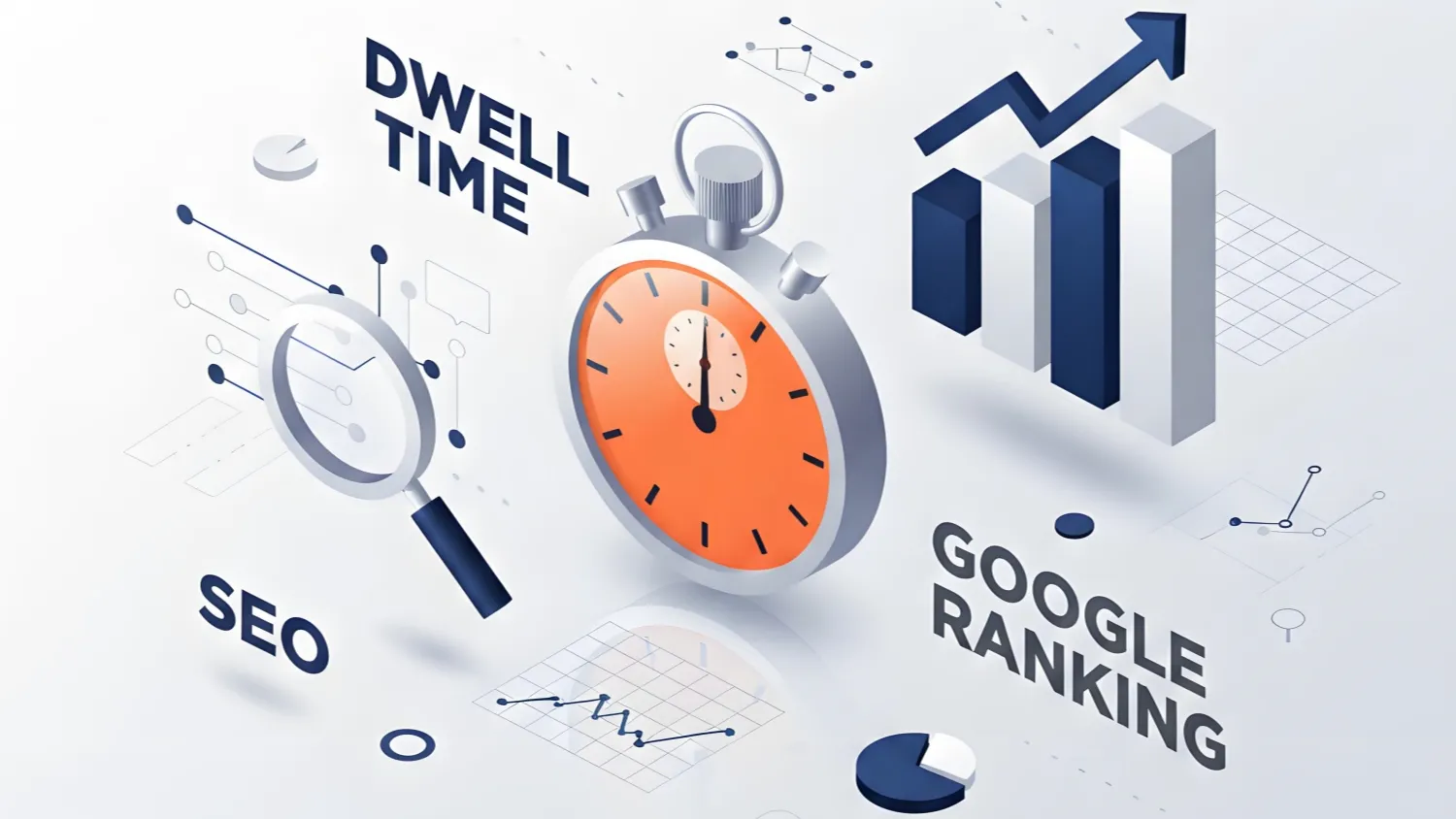
In professional SEO audits, Dwell Time refers to the duration between a user clicking on your website from the Google Search Engine Results Page (SERP) and the moment they return to the SERP. While related to “Average Engagement Time” in GA4, its significance is more profound: it is a core signal Google uses to measure “Search Intent Match.”
If a user clicks and immediately “bounces” back to the results page (known as Pogo-sticking), Google determines that your content failed to solve the user’s problem, subsequently lowering your ranking. As a business decision-maker, the differences in metrics you need to focus on are shown in the table below:
| Metric Name | SEO Practical Significance | Optimization Priority |
|---|---|---|
| Dwell Time | Reflects the “fit” between content and search terms; directly affects RankBrain scores. | Critically High |
| Average Engagement Time | Reflects the actual quality of interaction and UX performance on the page. | High |
| Engagement Rate (GA4) | Measures the precision of traffic and the page’s ability to retain visitors. | High |
To improve these metrics, optimization of the underlying architecture is crucial. You can consult our professional web development solutions to learn how we ensure high-performance website behavior at the code level.
Underlying Algorithm Logic: How Does Google “Read” User Satisfaction?
Google’s RankBrain machine learning algorithm has long evolved beyond simple keyword frequency matching. Based on our deep research into relevant Google patents (such as US10289736B2), the algorithm sets dynamic “satisfaction dwell thresholds” for different industries.
Patent Insight: What is US10289736B2?
This patent is titled “Systems and methods for ranking results based on dwell time.” It formally confirms that Google possesses a sophisticated system capable of monitoring the duration users stay on a webpage and using this as a key parameter for adjusting search rankings. The patent explicitly mentions that the system sets different “satisfactory time thresholds” based on different types of queries, meaning Google has the ability to distinguish between “quick information retrieval” and “deep reading.”
In our practical observations, user behavior in the Hong Kong market is highly “pragmatic”:
- B2B Consulting: Users require deep trust; ideal Dwell Time should be 2-3 minutes or more.
- Financial/Legal Services: Authority is core; users will repeatedly study terms, leading to longer dwell times.
- E-commerce/Retail: The pace is extremely fast; if product value isn’t shown within 30 seconds, users will churn rapidly.
As we enter 2026, with the proliferation of AI Agents (such as OpenAI’s Operator or DeepSeek’s autonomous assistants), the importance of Dwell Time is further amplified. AI tools (like Perplexity or DeepSeek) prioritize webpages with high engagement data when crawling for recommended information. This means if your content lacks depth, you will lose not only Google organic rankings but also future AI traffic gateways.
Data Diagnosis: How to Use GA4 to Identify Ranking “Drags”?
As a professional SEO company, we focus on the following three dimensions when conducting audits for clients:
1. Average Engagement Time vs. Content Length
If a 2,000-word deep-dive report has an average engagement time of less than 30 seconds, it indicates a serious misalignment in your “above-the-fold experience.” Users did not see the answers they wanted within the first 3 seconds.
2. Scroll Depth Gaps
Using GA4 custom events, we can precisely identify which paragraph causes users to stop reading. Usually, overly long background introductions are Dwell Time killers. We recommend the “Inverted Pyramid” writing style, providing core value in the very first paragraph.
3. Cross-Device Performance Diagnosis
Over 70% of commercial traffic in Hong Kong comes from mobile devices. If mobile Dwell Time is significantly lower than desktop, it is usually because Core Web Vitals (such as LCP or CLS) have not met standards. This requires intervention and optimization from a professional technical team.
If you are unsure whether your current data meets the mark, feel free to use our SEO consultation service. We will provide a detailed competitor data comparison report.
3 Practical Strategies to Increase Dwell Time
Based on YouFind’s years of SEO optimization experience, we have summarized a set of effective “Retention Rules”:
1. The 3-Second Rule: First Impressions of Performance and Visuals
Optimize LCP (Largest Contentful Paint) to ensure users see core content immediately after clicking. In Hong Kong’s fast-paced business environment, loading for more than 2.5 seconds means losing potential customers. Meanwhile, using real case study photos instead of stiff stock images can instantly build initial trust.
2. The 30-Second Rule: Structured Headings and “Reading Hooks”
Use H3-H5 tags to construct a clear reading path. Directly address user pain points in the introduction and promise a solution.
3. The 3-Minute Rule: Multimedia Interaction and Deep Value
Data shows that pages with embedded high-quality videos see an average Dwell Time increase of over 150%. Additionally, adding interactive calculators, FAQ accordions, or internal links to related deep-dive articles can effectively guide users to “explore deeply” within your site, building a perfect flow of authority.
Frequently Asked Questions (FAQ)
Does longer Dwell Time always mean higher rankings?
Not necessarily. Dwell Time must be viewed alongside “Conversion Rate.” If users stay a long time because they can’t find the inquiry button, that “dwell” is harmful to the business. We strive for “high-quality dwell”—where users generate an inquiry click or resource download after receiving value.
How does AI-generated content affect Dwell Time?
Purely AI-copied content lacks logical depth and authentic Experience. Users can easily identify it and leave quickly. In 2026, Google places more weight on the “Experience” aspect of the EEAT principles. This is why we insist on senior experts participating in content strategy formulation.
Does a high Bounce Rate mean low Dwell Time?
Not always. If a user stays on your page for 10 minutes, reads everything, and then leaves, it counts as a “bounce,” but the Dwell Time is extremely high, and Google will view this positively.
How can I accurately measure my website’s Dwell Time?
Since Google does not publicly release search-return data, we typically use GA4’s “Average Engagement Time” as the closest proxy metric.
Can video embedding really boost rankings?
Video itself is not a direct ranking factor, but it significantly boosts Dwell Time and user interaction, which indirectly drives rankings up.
Is mobile Dwell Time usually shorter than desktop?
Yes, mobile users typically prioritize efficiency. Therefore, “Above the Fold” optimization on mobile is even more critical than on desktop.
Will content that is too long cause users to lose patience and lower Dwell Time?
If the content lacks structure, yes. But if anchor links for a table of contents and clear subheadings are used, long-form content often yields higher Dwell Time.
What technical factors “weaken” Dwell Time?
Intrusive pop-ups, auto-playing audio, slow loading speeds, and cluttered layouts.
How can an SEO company help me optimize Dwell Time?
We optimize across three dimensions: Technical Performance (Speed), Content Strategy, and User Journey Guidance (UX/UI).
If my industry is very niche, will Dwell Time standards be lower?
Yes, Google RankBrain measures based on the average level of similar search results. Benchmarks for niche industries are different, which is why professional Omni-channel Marketing support is needed for precise benchmarking.
Returning to User Value is the Ultimate Path to SEO
Dwell Time is more than just an SEO metric; it is the user’s recognition of your brand’s professionalism. In the era of AI-driven search, only content that truly solves problems and provides deep insights can stand out in fierce ranking competitions. If you wish to systematically improve your website’s SEO performance and conversion capabilities, feel free to contact our expert team to learn more about our comprehensive Marketing support solutions.