
Over the past 20 years of SEO practice, we have seen countless business owners and marketing directors face the same dilemma: website traffic grows year after year, and the data on the reports looks beautiful, yet the sales department complains that “inquiry quality is terrible” or “the leads aren’t the right fit.” We call this phenomenon the “Traffic Vanity Trap.”
When a website is flooded with traffic that fails to convert, that data is essentially invalid traffic. In the era of AI search, simply chasing “rankings” is obsolete. The real victory lies in whether you can precisely capture high-value customers with a high intent to purchase. The core of achieving this lies in the strategic depth of your long-tail keyword deployment.
Is Your Traffic Increasing While Your Customers Decrease?
Many bosses watch the curves on Google Search Console (GSC) soar and feel initially elated, only to feel discouraged when they compare those numbers to back-end sales data. Why does this happen?
The issue usually isn’t that your SEO techniques are lacking, but rather a severe “intent mismatch” between your keyword strategy and business goals. Many enterprises over-pursue “broad industry terms” with massive search volumes (e.g., “renovation,” “accounting,” “legal services”) while ignoring the fact that the intent behind these terms is extremely vague. A visitor might just be looking for a renovation reference photo or checking a legal definition, rather than actually seeking to hire your services.
“Invalid traffic” doesn’t mean low traffic; it means you are attracting a crowd that “has no demand for your services” or “has no intention of paying yet.” To break this stalemate, we must re-evaluate the strategic position of long-tail keywords.
What is “Invalid Traffic”? Most Businesses Are Misled by SEO Data
In a professional SEO audit, our first step is to distinguish between “superficial prosperity” and “business value.”
What is Invalid Traffic?
In simple terms, invalid traffic refers to clicks that fail to bring substantive inquiries, fail to move the sales funnel, and have search intents that do not match the core business. It’s like a passerby walking into a department store just to enjoy the air conditioning with no intention of shopping.
Why High Rankings Don’t Equal High Conversions?
The keywords many companies take pride in are often definitional terms. While they may rank #1, users leave immediately after reading the definition—this is a classic “bounce.” While this traffic might slightly help brand awareness, the ROI is extremely low for businesses in urgent need of growth. Here is a comparison table we’ve prepared for decision-makers:
| Dimension | Invalid Traffic (Vanity) | Valid Traffic (Commercial) |
|---|---|---|
| Keyword Type | Broad industry terms, single concepts | Long-tail keywords, problem-oriented terms |
| User Intent | Querying definitions, browsing, info gathering | Comparing solutions, seeking providers, solving pain points |
| Conversion Potential | Extremely low; usually “read and leave” | Extremely high; clear intent to order or consult |
| Acquisition Cost | High (Fierce competition, low return) | Low (Relatively lower competition, precise return) |
The Three Most Common Sources of Invalid Traffic
- Obsession with Broad Industry Terms: For example, a law firm fighting for the word “Lawyer” instead of “Commercial dispute litigation lawyer fees in Hong Kong.” The former attracts students researching data; the latter attracts the actual clients.
- Content Designed to Please Algorithms: Stuffing keywords for rankings resulting in hollow content. Users leave without sensing professionalism, creating a negative brand impression.
- Ignoring Regional Attributes: For local HK service providers, attracting massive traffic from regions you cannot serve is a waste of resources.
Long-tail Keywords: Not “Small Traffic,” But “High Intent”
Many businesses misunderstand long-tail keywords, believing they are not worth the investment due to low search volume. However, in the eyes of senior SEO experts, this is where the treasure lies.
What is the Essence of Long-tail Keywords?
Long-tail keywords usually consist of three or more words. While individual volumes are low, their sum typically accounts for over 70% of the total search market. More importantly, they are the “language of decision-making.”
Imagine someone searching for “CRM” versus searching for “Cloud CRM system price comparison for a 50-person team.” Which one is closer to a deal? Clearly the latter. Long-tail terms contain “Problem + Scenario + Constraints,” indicating the user has entered the evaluation and action stage.
How Do Long-tail Keywords Filter Out 80% of Invalid Traffic?
This involves the Iceberg Theory of search psychology:
- The Tip (Broad Terms): Searchers are still exploring “Who am I? Where am I?”. Most of these people are just passing through.
- The Base (Long-tail Terms): Searchers know exactly what their problem is; they are looking for the “cure.” When your content precisely answers these complex long-tail questions, you naturally exclude those with no intention to buy.
What Brings “High-Value Customers” is Structure, Not Keyword Quantity
Simply “writing a few articles with long-tail keywords” is not enough. A true SEO strategy requires connecting these terms into a knowledge grid that guides conversion.
4 Search Characteristics of High-Value Customers
When screening keywords, check for these traits:
- Clear Demand: They search for solutions to specific problems, not just concepts.
- Clear Identity: The search context carries industry attributes (e.g., Marketing tools for medical aesthetics).
- Clear Scenario: Includes the application environment (e.g., Office relocation cleaning services).
- Clear Next Action: Includes verbs like “compare,” “fees,” “reviews,” or “recommendations.”
Why Do Most Businesses Fail Despite Having Long-tail Keywords?
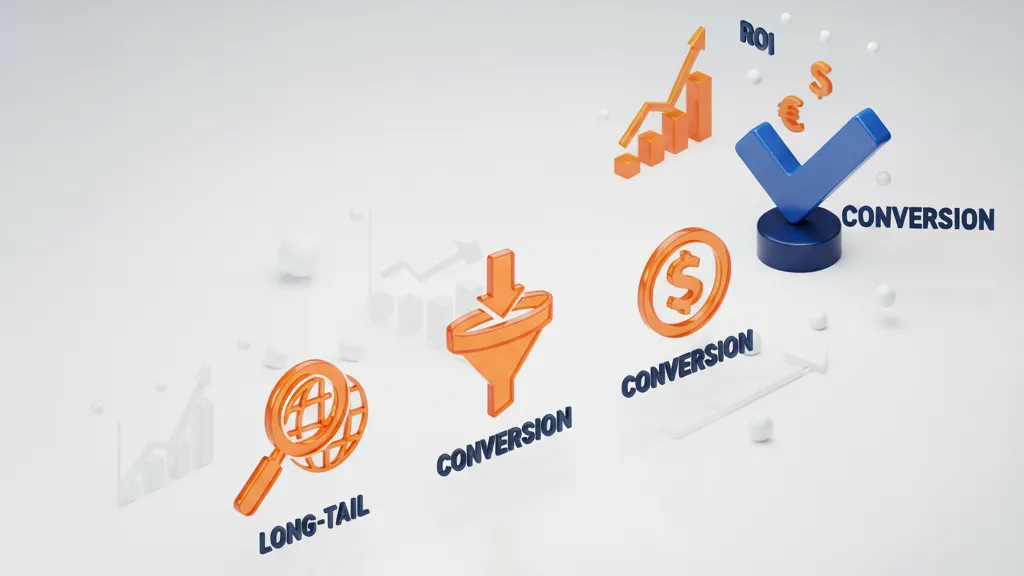
This is due to a lack of “Conversion Path Design.” Many articles are well-written, but after reading, the user doesn’t know what to do next. Professional deployment should follow this path: Informational Long-tail → Guide to Solution Content → Link to Case Studies → Lead to Inquiry Form. If your long-tail content is fragmented without establishing a flow of authority, Google cannot determine your professional depth (E-E-A-T) in that field.
How Should Enterprises Systematically Deploy Long-tail Keywords to Reduce Invalid Traffic?
The “Precision Customer Acquisition Trilogy” combines AI technology with human insight:
Step 1 | Use AI Audit to Identify “Traffic Mismatch Zones”
Use AI auditing tools to analyze your existing traffic structure. Which pages rank but have a 90% bounce rate? Which pages have tiny traffic but contribute the most inquiries? Through data cleaning, we identify hidden invalid traffic sources and adjust the strategy decisively.
Step 2 | Establish “Long-tail Keyword Intent Layering”
Layer keywords by “Conversion Heat” to ensure your content budget is spent effectively:
| Level | Keyword Type | Content Focus |
|---|---|---|
| Information (Top) | “What is…”, “Trends in…” | Build professionalism, answer basic questions, cast a wide net. |
| Comparison (Mid) | “Difference between A and B”, “Recommended providers” | Demonstrate experience, analyze pros/cons, filter high-value customers. |
| Decision (Bottom) | “…Service fees”, “Reviews for HK … company” | Strong conversion guidance, providing case studies and credentials. |
Step 3 | Win with Content Structure, Not Article Quantity
In the AI era, Google prioritizes “Topical Authority.” We recommend a “Pillar Page + Cluster Articles” structure. For one core long-tail need, produce deep, original content with real-world “Experience”—this is far more useful than writing 10 generic AI-generated snippets.
Redefining Long-tail Keywords in the AI Search Era
We have entered the new battlefield of GEO (Generative Engine Optimization). Google AI Overview and ChatGPT are changing how users acquire information.
AI No Longer “Looks at Words,” It “Understands Needs”
SEO used to be keyword matching; AI search is now “semantic understanding.” AI retrieves long-tail content that provides “complete, precise, and uniquely insightful” information. If your article just repeats clichés found elsewhere, AI will never recommend you to users.
Why are “Long-tail Needs” More Likely to Be Selected by AI?
- Clarity: AI loves clear questions because it can provide precise answers.
- Verification Difficulty: Professional answers to complex long-tail questions often carry unique data or cases, which serve as “high-quality signals” for AI.
- Contextual Fit: When users engage in multi-turn dialogues with ChatGPT, the more constraints they provide, the more they align with the long-tail keyword contexts we deploy.
The Real Question Enterprises Should Ask: Not “Whether to do SEO,” but “Whether to Continue Wasting Traffic”
In an era of information explosion, blindly chasing traffic is a form of strategic laziness. 10,000 clicks a month with 0 conversions is worth far less than 100 clicks with 10 precision inquiries.
The goal of SEO has never been rankings; it is continuously acquiring the right customers. Through precise long-tail keyword deployment, we can effectively filter invalid traffic, establish brand authority, and turn every click into potential profit.
If you find that your website traffic is high but your business isn’t growing, it might be time to examine your keyword structure. Do you know what percentage of your website is invalid traffic?
Want to obtain a “Precision Customer Acquisition Keyword Blueprint” tailor-made for your business? Contact us today and let us help you transform traffic into true brand assets.