
The magnetic field has shifted, and traffic is being intercepted. As a Hong Kong business decision-maker, if you find that your website’s Google keyword rankings remain firmly on the first page, yet your website click-through rate (CTR) and enquiries (Inquiry) have dropped sharply, this is no coincidence. Today, with Generative AI fully taking over search engines, the rules of traditional SEO have been completely rewritten.
Why does “ranking first” no longer equal “closing business”?
Over the past two decades, the digital marketing logic for Hong Kong enterprises was very simple: buy keywords, do SEO, and secure the first page of Google. As long as you appeared in front of users, there would be clicks and opportunities for conversion. However, with the popularisation of Google Search Generative Experience (SGE) and AIO (AI Overviews), search behaviour has undergone a qualitative change.
Now, when potential customers search Google for “best logistics solutions in Hong Kong”, Google no longer merely provides a row of blue links. Instead, Generative AI directly summarises a concise answer. This answer occupies the most valuable top position on the screen and comes with a small number of “citations”.
Defining the business crisis: The “digital invisible person” forgotten by AI
This is the “citation authority” crisis brands are facing: if your brand does not appear in the AI citation list, users have already obtained the answer after reading the AI summary, or may even directly click on the competitor recommended by AI. Although your website may still rank first in the traditional results below, you have completely lost the “first touchpoint”.
| Evaluation dimension | Traditional search era (Search 1.0) | AI search era (Search 2.0 / AIO) |
|---|---|---|
| Core metric | Keyword ranking | Citation Authority |
| Traffic destination | Clicking links to enter the official website | Traffic stays in AI summaries (Zero-click Search) |
| Trust building | Users browse the official website and judge for themselves | AI endorsement and recommendation |
| Competitive battlefield | Webpage tags and number of backlinks | Semantic relevance and GEO Score™ authority signals |
In the AIO era, Google’s role has changed from a “navigator” to an “advisor”. If a brand cannot enter the core citation process of AI, the budget you invest in content creation will ultimately only provide training material for AI, without bringing back any business conversions.
Citation authority: The “conversion threshold” that determines corporate survival in the AI era
In the operating logic of Generative AI, it does not randomly scrape information. AI search engines such as Google AIO, Perplexity and ChatGPT Search have an extremely rigorous filtering mechanism, known as “Citation Weight”.
Core logic: The information filtering mechanism in the AI era
AI search engines are no longer simple traffic referral tools; they directly transform information. If a brand is not marked by AI as an “authoritative source”, it will completely lose the opportunity to establish first trust with potential customers. Many Hong Kong enterprises have high-quality content, yet still cannot be cited by AI. The core reason is that the brand has failed to establish authority signals that meet GEO standards.
When AI captures information, it evaluates the following three dimensions:
- Entity Authority: Is the brand recognised as an expert in a specific field by multiple authoritative sources, such as news and industry reports?
- Information Gain: Does your content provide unique insights that AI cannot generate through its base training model?
- Semantic Structure: Can the content be easily identified by the AIPO engine and incorporated into its knowledge graph?
Commercial value: Upgrading from click competition to “trust monopoly”
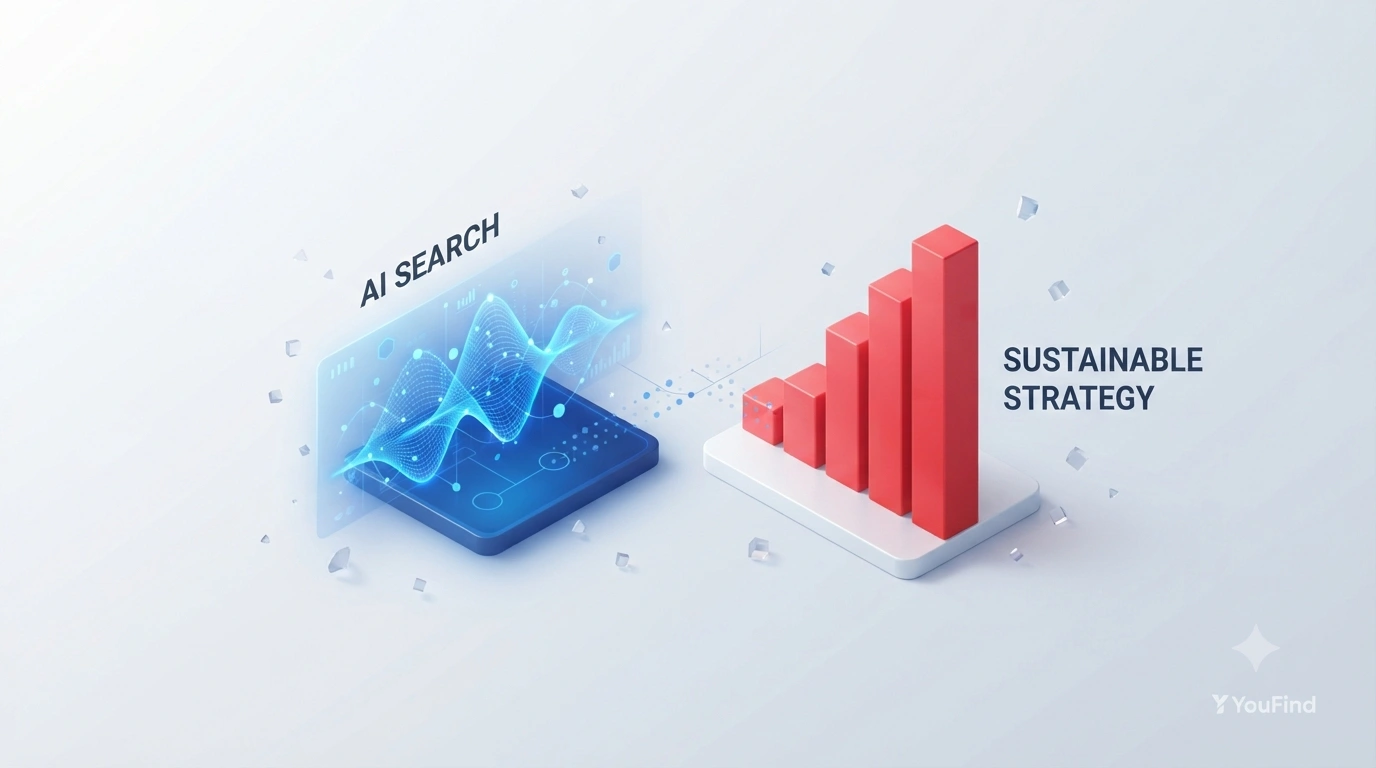
YouFind AIPO helps brands upgrade from simple click competition to a “trust monopoly” within the AI ecosystem. When a potential customer asks a professional question and Google AI recommends only your brand as the sole authoritative source, the strength of this endorsement far exceeds any paid advertisement. The YouFind AIPO system can ensure that brands are prioritised in every AI conversation, achieving a 3.5-fold increase in citation rate.
YouFind exclusive: Patent-level “AI visibility diagnosis” reveals brand blind spots
Facing the black-box logic of AI search, blindly guessing the algorithm is futile. As a pioneer with 20 years of deep experience in digital marketing, YouFind has developed one of the few patented technologies in the market capable of quantifying AI performance — AI visibility diagnosis and the GEO Score™ algorithm.
Instead of blindly spending, diagnose precisely
Rather than changing your website architecture or blindly increasing your budget, YouFind’s exclusive diagnostic mechanism can accurately warn you of where your brand is losing “invisible conversion opportunities” in AI’s mind. This system can identify which high-value keywords are being “pre-empted” by competitors in AI summaries.
Four core indicators in the YouFind diagnostic report:
- AI citation share: Monitors how frequently the brand is mentioned by Google AIO within specific product categories.
- Competitor interception analysis: Reveals which competitors are using Generative AI to capture traffic from your official website.
- Semantic gap diagnosis: Identifies which professional information in your website content has failed to be converted into AI-readable signals.
- Conversion exposure assessment: Quantifies the potential order loss caused by not being cited.
Recommended action: Take back potential orders intercepted by AI
The iteration speed of AI search is far beyond imagination, and traditional SEO strategies are no longer sufficient. Brand decision-makers should immediately launch an “AI visibility diagnosis” to reclaim potential orders intercepted by AI. Through YouFind’s algorithm monitoring tools, you will clearly see the complete path of your brand from “being searched” to “being recommended”.
Brand AI exposure self-checklist
If you are unsure whether your brand is in crisis, please compare against the following points:
- When searching for your brand’s core products, do competitors appear in Google AI summaries, but not you?
- Although your keywords rank in the top three, has your organic click-through rate (CTR) continued to decline over the past six months?
- Is your official website content too fragmented and lacking expert-level arguments that can be directly extracted by AI?
- Are your brand’s relevance signals on third-party authoritative platforms, such as professional forums and authoritative news, extremely weak?
If more than two of the above apply, your brand is becoming a “digital invisible person” in the AI era.
👉 You can first use our free GEO audit tool to help list the content gaps across your entire site as a concrete checklist:
Run a free GEO audit nowFAQ: Frequently asked questions about Generative AI and AIPO
Q1: If my industry is highly regulated, such as finance or healthcare, is AI citation harder to achieve?
Quite the opposite. Google AIO is extremely cautious with citations in “Your Money Your Life” (YMYL) fields. These industries rely even more on the “Trust” indicator within E-E-A-T. Through AIPO, building content with professional qualifications, certifications and structured data can actually make it easier than in ordinary industries to obtain a “sole citation” in AI summaries, because AI does not dare to casually cite non-professional sources.
Q2: Will GEO optimisation affect the performance of my existing keyword ads (SEM)?
The two are complementary. GEO enhances the brand’s “baseline credibility” in AI’s mind. When users see your brand cited in AI summaries and then see your advertisement on the search results page, the click conversion rate (CVR) usually improves significantly, because AI’s endorsement has already removed the customer’s trust barrier in advance.
Q3: Do I need to rewrite thousands of pages across the entire site for AI search?
No. YouFind’s diagnostic tool identifies the 20% of “core pages” that contribute most to business conversions. We recommend a “focused strike” strategy, using the AIPO system to first optimise high-value commercial entity pages rather than blindly changing the entire site.
Q4: Why are the answers given by Perplexity and ChatGPT different from Google AIO?
Because each generative engine has different training models and real-time crawling weights. This is exactly why GEO Score™ is important — it helps you monitor brand visibility across different AI ecosystems, ensuring that your brand can maintain a consistent authoritative image across multiple “AI brains”.
Q5: Does AI citation authority require a long time to show results, like traditional SEO?
AI crawling frequency and update speed are much faster than traditional indexing. Once your website establishes authority signals that meet AIPO standards, such as semantic link repair, changes in AI citation ratios can usually be observed within a few weeks, rather than the months of observation often required by traditional SEO.
Q6: My brand is cited by AI, but there are no clicks. What tangible business value does this bring me?
This involves “brand premium” and “mental ownership”. Even if there is no immediate click, being marked as the “preferred recommendation” in AI answers establishes a leading position in users’ minds. When users enter the final decision-making stage, your brand will become their “top-of-mind” choice, reducing overall customer acquisition costs.
Q7: If AI cites my content, will it instead encourage users not to click on my website?
This is the reality of “zero-click search”. However, being cited by AI without clicks is still far better than “being replaced by a competitor’s citation”. AIPO’s strategy is to guide AI to provide “inspiring answers”, leaving suspense or guiding links in the summary to encourage customers with deeper needs to click further for solutions.
Q8: Apart from text, what role do images and videos play in Generative AI optimisation?
They are extremely important. Today’s AI summaries are increasingly multimodal. YouFind’s AIPO framework also includes image-text relevance optimisation, ensuring that your product images or demonstration videos can appear in the right-side chart positions of AI summaries, increasing visual brand exposure.
Q9: There are many AI writing tools on the market. How is this different from YouFind’s AIPO?
AI writing tools merely “produce content”, while AIPO “defines signals”. Having more content does not mean it will be cited. AIPO focuses on solving the technical chain of “how to make Google trust this content”, rather than simply piling up words. Low-quality AI-generated content may instead cause the brand to be downgraded by AI.
Q10: If competitors also start doing GEO, how can I maintain my leading advantage?
This is a competition of “authority moats”. AI tends to cite brands with greater historical depth, data support and multi-party verification. The earlier an enterprise starts deploying AIPO, the more stable its nodes in AI’s knowledge graph become. Latecomers will need several times the cost to shake your citation authority.
Would you like to gain an in-depth understanding of your current website content’s specific score in Google AIO? I can provide a detailed interpretation of each dimension of GEO Score™ for you.