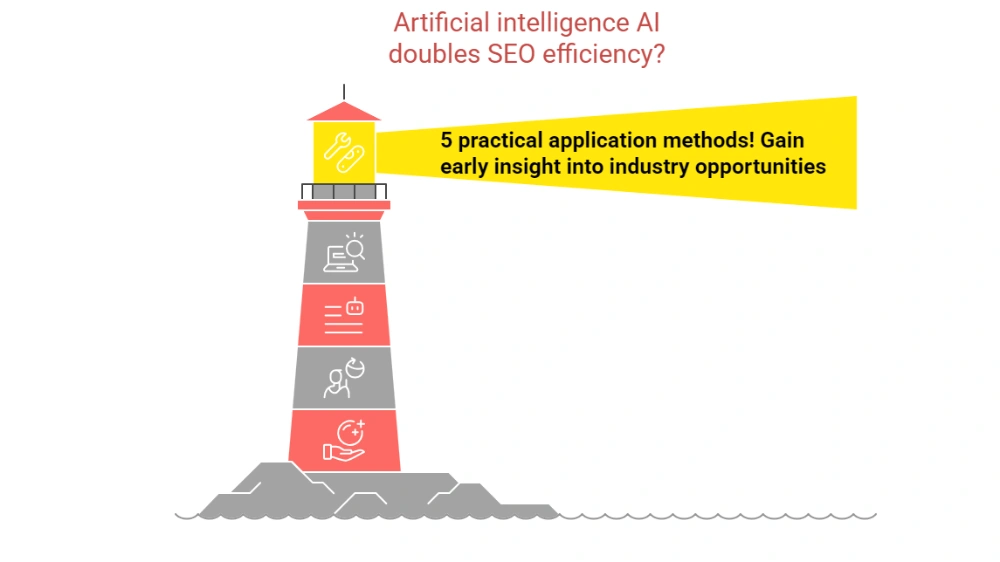


Over the past few years, many businesses have observed that despite consistently publishing content, optimizing keywords, and acquiring more backlinks, their website’s search rankings remain stagnant. This is not a matter of luck; rather, the fundamental logic of search engines is undergoing the most profound transformation in a decade. Google has fully entered the era of AI-Powered Optimization (AIPO)—search results no longer solely rely on traditional link authority and keyword matching. Instead, the results are driven by Artificial Intelligence, which directly generates summaries, integrates information, and even provides complete answers before the user clicks on any website. When users stop clicking links, your website traffic will quietly shrink. This is the root cause of many businesses’ confusion: “How can I resolve my stalled SEO ranking?” The answer is not in posting more frequently, but in understanding “How AIPO Impacts SEO Rankings,” proactively mastering “How to Use AI to Boost SEO Efficiency,” and systematically focusing on “How to Prepare Content for AI Services” starting now.
How AIPO Impacts SEO Rankings: The Traditional Ranking Logic Is Crumbling
Before AIPO, search engine rankings were primarily dependent on a webpage’s technical structure, the number of external links, and the frequency of keyword appearance. Today, however, Google’s search results are progressively being replaced by “AI Snippets” or summaries. When a user enters “Most recommended baby milk powder brands in Hong Kong,” the system no longer just lists ten product pages. Instead, it directly presents a summary that integrates expert opinions, user reviews, nutritional comparisons, and local purchase channels. This means that even if your website ranks first according to traditional metrics, if it is not selected by the AI model as a source of information, you will face the challenge of “Zero-Click Searches.”
Three Major Shifts in Search Behavior
- From Click-Oriented → Summary-Oriented: The way users acquire information shifts from “clicking a website” to “reading the AI summary,” directly leading to a decrease in website traffic.
- From Keyword Matching → Semantic Understanding: AI understands that “how to lose weight” and “effective slimming methods” represent the same need, no longer relying on exact keyword repetition.
- From Page Authority → Content Credibility: AI is more inclined to cite content that features original data, expert endorsements, and genuine case studies, rather than marketing-driven, templated articles.
This is the core of “How AIPO Impacts SEO Rankings”: rankings are no longer determined by “who writes the most,” but by “whose content is most worthy of being cited by AI.” If your content lacks depth, uniqueness, or fails to provide verifiable information, even perfect technical execution will make it difficult to gain a foothold in the AIPO era.
How to Use AI to Boost SEO Efficiency: From Manual Operations to Intelligent Decisions
Faced with the AIPO challenge, the correct approach for businesses is not to resist artificial intelligence, but to leverage it as an accelerator. Artificial Intelligence is not meant to replace SEO professionals, but to free up human resources from repetitive tasks so they can focus on creating high-value content. Here are three of the most effective and practical application scenarios to help you implement “How to Use AI to Boost SEO Efficiency.”
1. AI-Driven Keyword and Search Intent Analysis
Traditional keyword tools only provide search volume and competition level, but AI can analyze the user’s true needs. For instance, by analyzing Google Search suggestions, Q&A platforms, and community discussions, AI can identify long-tail semantics such as “Which baby milk powder in Hong Kong is closest to breast milk” or “How to determine if a milk powder suits a baby’s digestive system.” These are the contexts that the AIPO model values most, rather than the single keyword “baby milk powder.” Using AI tools for semantic graph analysis allows for precise targeting of the problems users are truly trying to solve, preventing the “stalled SEO ranking due to wrong keywords.”
2. AI-Assisted Content Creation and In-Depth Optimization Process
The most efficient content production model is “AI Draft + Human Deep Enhancement.” AI can generate a structurally complete initial draft covering the main questions within minutes, but the real value lies in the subsequent human optimization: incorporating local clinical research data, genuine customer case studies, expert interview content, and product testing reports. This “AI Efficiency + Human Expertise” dual-track model allows the content to simultaneously satisfy the search engine’s semantic understanding and the user’s need for trust, which is a key strategy for resolving “How to resolve stalled SEO ranking.”
3. AI Competitor and SERP Pattern Analysis
The content strategy of your competitors is often your best textbook. AI can automatically capture the content structure, paragraph length, citation sources, image types, and Q&A formats of the top five search results, and analyze “which content is frequently cited by AI summaries.” For example, if the majority of top results include the “Hong Kong Department of Health Recommended List” or “2024 Local Mom’s Real-World Test Report,” these are the “trust signals” recognized by the AIPO model. Through this analysis, you can quickly adjust your content direction and avoid investing resources in the wrong areas.
AI Audit: Identifying Hidden Problems Hindering Rankings
Many websites stall in their rankings not because their content is too little, but because it is “too shallow.” AI can automatically check content depth indicators, such as:
- Does it include specific data, times, locations, or sources?
- Does it feature expert opinions, research citations, or first-hand experience?
- Does it answer the follow-up questions a user might potentially ask?
Through AI Content Gap analysis, businesses can precisely locate the “trust gaps” in their content and targetedly reinforce them. This is the highest level of application for “How to Use AI to Boost SEO Efficiency.”
How to Prepare Content for AI Services: Building an Information Foundation that AI Trusts
No matter how advanced the AI tool you use is, all efforts will be in vain if there are no “raw materials” for AI to cite. The AIPO model requires content data that is “structured, credible, and verifiable.” Businesses must start now to systematically prepare “How to Prepare Content for AI Services,” or risk being eliminated from the market within the next six to twelve months.
Five Content Assets Businesses Must Establish
- Authoritative Data Source Authorization: For example, collaborating with local medical institutions, nutritionists, or professional associations to obtain authorization to use their research data or expert reviews, and clearly labeling the source.
- Standardized FAQ Database: Organizing common questions and precise answers in a clear format (e.g., Question → Answer → Data Support → Source Link) for easy AI extraction.
- Expert Profiles and Public CVs: Setting up a “Professional Team” page on the website, clearly listing qualifications, degrees, professional certifications, and actual service experience to enhance content credibility.
- Original Data and Technical Details: Product specifications, ingredient lists, testing reports, production processes, and certification marks should be presented using structured data (such as JSON-LD), not just as images or text descriptions.
- Customer Scenarios and Genuine Case Studies: Collecting and organizing real user experiences, problem-solving processes, and results, presented in a story-like manner to strengthen situational relevance.
What is the Impact of Not Preparing Content for AI Services?
If a business remains in the stage of “publishing marketing articles,” it will face a triple crisis:
| Traditional Model | AIPO Era Model |
|---|---|
| Relies on keyword density and backlink quantity | Relies on content depth, credibility, and data extractability |
| Content is sales-oriented | Content is problem-solving-oriented |
| Ranking depends on “writing the most” | Ranking depends on “being cited the most” |
| Traffic source is stable | Traffic is consumed by AI summaries, click-through rate plummets |
| Difficult to quantify content value | Content credibility can be precisely evaluated through AI analysis tools |
When the AI model cannot extract credible data from your website, it naturally will not list you as a recommended source. This is not a drop in ranking, but being “ignored.” This is the real reason why “How to Prepare Content for AI Services” is a matter of urgent priority.
In the AIPO Era, Only By Using AI Can You Surpass AI
The rules of the search engine game have fundamentally changed. In the past, SEO was a race of “who can write more, faster”; today, it is a test of “whose content is most trusted by Artificial Intelligence.” If you are struggling with “How to resolve stalled SEO ranking,” first ask yourself: Does your content possess the depth and credibility required by AI? If you want to take control of future traffic, you must simultaneously understand “How AIPO Impacts SEO Rankings,” actively utilize “How to Use AI to Boost SEO Efficiency,” and systematically focus on “How to Prepare Content for AI Services” starting today.
This is not a future trend; it is a reality happening now. Google’s AI model is learning every day, but is your website ready?
In the AI-dominated search era, a website’s visibility is no longer determined by the volume of content, but by the structure and credibility of the information. Businesses that can systematically organize expert opinions, original data, and genuine case studies are more likely to be selected by the AI model as a source of information, thereby maintaining influence in zero-click searches. Conversely, content that relies on templated copy and lacks supporting evidence, even if it once ranked highly, will gradually be marginalized as AI continues to learn and optimize. Future search traffic will favor websites that have already proactively established **”citable content assets”—**this is not a marketing trick, but the natural evolution of the digital information ecosystem.